WISP Template for TPAs
A written information security program (WISP) is the first document plan sponsors, auditors, and regulators ask a TPA for. Here is what the rules actually say, the 18 policy areas the Department of Labor lists, and a free Word template built around them.
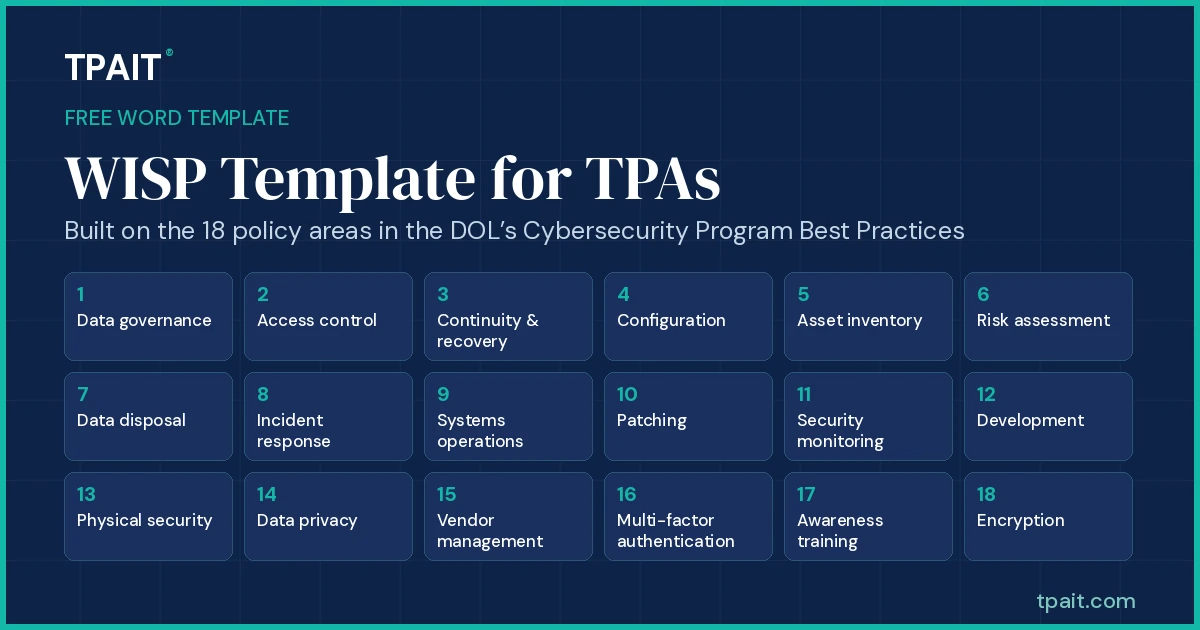
The short answer: no single federal rule says “every TPA must have a WISP.” But the Department of Labor’s first cybersecurity best practice is a formal, well documented cybersecurity program. Massachusetts requires a written program from any business that holds its residents’ personal information. HIPAA requires written security policies from TPAs that act as business associates of health plans. And the DOL’s hiring tips tell plan sponsors to ask a provider about its security standards, audit results, past breaches, and insurance. A TPA without a written program has nothing to hand over when that first question arrives.
“Under the program, the organization fully implements well-documented information security policies, procedures, guidelines, and standards to protect the security of the IT infrastructure and data stored on the system.” Source: EBSA, Cybersecurity Program Best Practices, practice 1 (opens in new tab)
What the Rules Actually Say
Six sources come up most often. Which ones reach your firm depends on the plans you serve, who your clients are, and where participants live.
| Source | Who it reaches | What it asks for in writing |
|---|---|---|
| DOL Cybersecurity Program Best Practices (opens in new tab) | Recordkeepers and other service providers responsible for plan-related IT systems and data, for all ERISA plans. It is guidance, not a regulation, written for service providers and for the fiduciaries who hire them. | “A formal, well documented cybersecurity program,” with policies approved by senior leadership, reviewed at least annually, and covering 18 listed areas. |
| Massachusetts 201 CMR 17.00 (opens in new tab) | Every person that owns or licenses personal information about a Massachusetts resident. The rule counts a business that receives, stores, maintains, processes, or has access to that information while providing services. | “A comprehensive information security program that is written in one or more readily accessible parts,” with ten required elements and a list of computer security requirements. |
| HIPAA Security Rule, 45 CFR 164.316 (opens in new tab) | TPAs that handle electronic protected health information as a business associate of a health plan. | Security policies and procedures kept “in written (which may be electronic) form” and retained for six years. |
| FTC Safeguards Rule, 16 CFR Part 314 (opens in new tab) | “Financial institutions” under the Gramm-Leach-Bliley Act. We have not found FTC guidance that names retirement plan TPAs, so ask counsel. See the note below the table. | A comprehensive written information security program, a qualified individual in charge, a written risk assessment, and a written incident response plan. Some items are waived for firms holding information on fewer than 5,000 consumers. |
| SEC Regulation S-P, 17 CFR 248.30 | Broker-dealers, investment companies, registered investment advisers, and transfer agents. It reaches a TPA by contract when the TPA is their service provider. | Written policies and procedures, including an incident response program and oversight of service providers, who must report a breach within 72 hours. |
| State insurance data security laws (NAIC Model Law 668) (opens in new tab) | Firms licensed under a state’s insurance laws, in the 28 jurisdictions NAIC counts as having adopted the model as of November 3, 2026. The model exempts licensees with fewer than ten employees from the program requirement. | A comprehensive written information security program based on a risk assessment, plus a written incident response plan. |
About the FTC rule. The Safeguards Rule defines a financial institution by its activities, using a list kept by the Federal Reserve. That list includes “providing administrative services to plans” as part of employee benefits consulting (12 CFR 225.28(b)(9)(ii) (opens in new tab)). The same rule also says a person is not your consumer solely because they participate in a plan you sponsor or serve as trustee or fiduciary. Whether a particular TPA is covered is a question for counsel, not something the FTC has answered in the guidance we reviewed.
Other states, including New York, Oregon, Rhode Island, and Nevada, require reasonable safeguards or a security program without using the word “written.” A written program is still the simplest way to show you have one. To see which rules are likely to reach your firm, try the free TPA Cyber Rules Navigator.
The 18 Policy Areas the DOL Lists
Practice 1 of the DOL’s best practices says a program should have “formal and effective policies and procedures governing all the following.” The left column is the DOL’s wording. The right column is what a TPA’s document should answer.
| DOL policy area | What your WISP should answer |
|---|---|
| 1. Data governance and classification | What plan and participant information you hold, where it lives, who is responsible for each system, and how sensitive data is labeled. |
| 2. Access controls and identity management | How access is requested, approved, reviewed, and removed. Unique logins and the least access each job needs. |
| 3. Business continuity and disaster recovery | What must keep running in an outage, how fast you will recover, how backups work, and how often you test. |
| 4. Configuration management | Standard secure settings for computers, servers, and cloud services, and how changes are approved. |
| 5. Asset management | A current inventory of hardware, software, and cloud services, with an owner for each. |
| 6. Risk assessment | Who assesses risk, how often (the DOL’s second practice says annually), and how findings are tracked until fixed. |
| 7. Data disposal | How long records are kept and how paper and electronic information is destroyed. |
| 8. Incident response | Who is called, who decides, what gets written down, and the notice deadlines in your contracts and state laws. |
| 9. Systems operations | Day-to-day procedures: backups, file transfers, log review, and who handles alerts after hours. |
| 10. Vulnerability and patch management | How quickly updates are installed, how you scan for weaknesses, and how exceptions are approved. |
| 11. System, application and network security and monitoring | Firewalls, protection on every computer, email filtering, and who watches for intrusions. |
| 12. Systems and application development and performance | If you build or customize software: testing, review, and keeping test work away from live participant data. If you do not, say so. |
| 13. Physical security and environmental controls | Office access, visitors, locked storage, clear desks, and where servers sit. |
| 14. Data privacy | What personal information you collect, why, who you share it with, and the limits in your contracts. |
| 15. Vendor and third party service provider management | How you vet providers before hiring, what your contracts require, and how you review them each year. |
| 16. Consistent use of multi-factor authentication | Where MFA is required, such as email, remote access, administrator accounts, and recordkeeper portals, and how exceptions are handled. |
| 17. Cybersecurity awareness training, which is given to all personnel annually | The training schedule, phishing tests, and completion records. |
| 18. Encryption to protect all sensitive information transmitted and at rest | What is encrypted in storage and in transit, including laptops, backups, email, and file transfers. |
Five Tests the DOL Applies to Those Policies
The same practice lists criteria for the policies themselves. A reviewer will look for evidence of each:
- Approval by senior leadership. A signature and a date, not an unsigned draft.
- Review at least annually, with updates as needed. Keep a log that shows each review.
- Terms effectively explained to users. Training and signed acknowledgments.
- Review by an independent third party auditor who confirms compliance. This ties to the DOL’s third practice, an annual third-party audit of security controls. See SOC 2 for TPAs.
- Documentation of the framework used to assess the security of your systems and practices, such as the NIST Cybersecurity Framework.
If You Hold Massachusetts Residents’ Data
Massachusetts is the clearest state mandate, and it is written around the resident, not the business. Its regulation lists ten things every written program must include: a named employee who maintains the program, a risk assessment that covers training and detection, rules for records taken outside the office, discipline for violations, cutting off access for people who leave, oversight of service providers by selection and by contract, physical access limits and locked storage, regular monitoring, a review at least annually or when the business changes, and a documented response and post-incident review for any breach. The template includes a cross-reference table so you can show where each one is covered.
Mistakes That Sink a WISP
- Brackets still in it. An unedited template tells a reviewer nobody owns the document.
- It says more than you do. Write what you actually do, then improve it. A document describing controls you do not run will not survive a sponsor’s follow-up questions.
- No owner and no dates. Name the person responsible, and date every approval and review.
- Vendors are missing. Recordkeeper connections, payroll feeds, and software providers belong in it. See recordkeeper and payroll integration security.
- Filed and forgotten. The DOL expects a review at least once a year. So does Massachusetts.
Get the Free WISP Template
An editable Word document, 11 pages, built for retirement plan TPAs:
- All 18 DOL policy areas, in the DOL’s order, with fill-in statements and the records to keep for each
- An approval page, version history, and annual review log
- A Massachusetts 201 CMR 17.03 cross-reference
- An incident log, a service provider register, and an employee acknowledgment form
Thank you. Your template is ready.
Download the WISP Template (Word)
Replace the bracketed items, have your leadership approve it, and review it at least once a year.
We use your details to provide the template and may follow up about it. We never sell your information. See our Privacy Policy. This form is protected by reCAPTCHA; the Google Privacy Policy (opens in new tab) and Terms of Service (opens in new tab) apply.
Frequently Asked Questions
Is a WISP legally required for a retirement plan TPA?
It depends on the firm. No single federal rule requires one of every TPA. The DOL’s best practices, which apply to service providers for ERISA plans, call for a formal, well documented cybersecurity program. Massachusetts requires a written program from any business that holds personal information about its residents, and HIPAA requires written security policies from TPAs that act as business associates of health plans. Plan sponsors also ask for it during due diligence.
What is the difference between a WISP and an incident response plan?
An incident response plan is one part of a WISP. The WISP is the whole program: who is responsible, how risk is assessed, and the policies for access, vendors, training, encryption, and the rest. Incident response is number 8 of the 18 policy areas the DOL lists.
How often should a TPA update its WISP?
At least once a year. The DOL’s criteria call for review “at least annually with updates as needed,” and Massachusetts requires a review at least annually or whenever there is a material change in business practices that may affect the security of personal information.
Does the IRS WISP requirement apply to TPAs?
IRS Publication 5708 is written for tax and accounting practices and does not mention TPAs. The IRS says a retirement plan administrator who prepares Forms 5500, 8955-SSA, and 5558 does not need a PTIN for that work. If your firm also prepares income tax returns, the FTC Safeguards Rule lists tax preparation services as financial institutions, and the IRS publication applies to that work. Either way, Publication 5708 is a useful free model.
This page and the template are general information, not legal advice. They do not guarantee compliance with any law, regulation, or contract. Have your counsel review your program. Sources: DOL best practices (opens in new tab), 201 CMR 17.00 (opens in new tab), IRS Publication 5708 (opens in new tab), IRS PTIN FAQ (opens in new tab), and NAIC adoption map (opens in new tab).
Want Help Putting It Into Practice?
A free assessment compares what your firm does today against the DOL’s 12 best practices and shows where a written program would have gaps.
Book Free IT & Cyber Assessment (opens in new tab)