Form 8955-SSA Moves to IRIS
The IRS’s FIRE system takes its last information returns on November 19, 2026. Starting with filing year 2027, Form 8955-SSA goes through IRIS, and the sign-in, access, and file-handling choices a TPA makes now decide who can file, who can see participant Social Security numbers, and what happens when someone leaves.
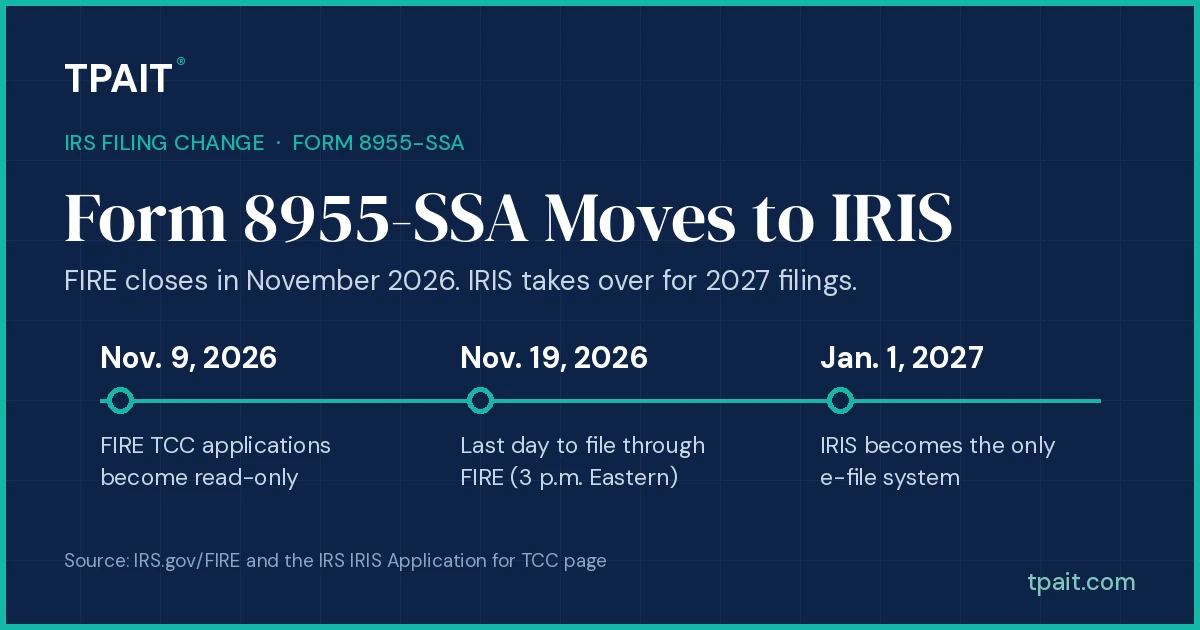
The short answer: FIRE, the system many TPAs and their software have used to e-file Form 8955-SSA, is being retired. The IRS stopped accepting new FIRE applications for a Transmitter Control Code (TCC), made existing applications read-only after November 9, 2026, and will take the last FIRE filings at 3 p.m. Eastern on November 19, 2026. After January 1, 2027, IRIS, the Information Returns Intake System, is the only electronic filing system for these returns, including prior-year returns and corrections, and the IRS says IRIS will accept Form 8955-SSA beginning with filing year 2027. A FIRE TCC does not carry over. If your firm files, or your software files under your firm’s TCC, someone needs to apply for an IRIS TCC now.
“IRIS will be the only information returns electronic filing system, including current year, prior year, or corrections, after Jan. 1, 2027.” Source: IRS, Filing Information Returns Electronically (FIRE) (opens in new tab)
Who This Affects
Form 8955-SSA reports separated participants who still have vested benefits in the plan. It is due by the last day of the seventh month after the plan year ends (July 31 for calendar-year plans), and Form 5558 can extend that by two and a half months. For plan years beginning on or after January 1, 2024, a filer required to file at least 10 returns of any type with the IRS during the calendar year generally must file it electronically, according to the IRS (opens in new tab).
That threshold reaches most plan sponsors and the TPAs who prepare and transmit for them. How the filing gets to the IRS varies by firm:
- Your firm transmits directly under its own TCC. You need your own IRIS TCC.
- Your compliance software transmits for you. Ask the vendor, in writing, whether it will file through IRIS under its TCC or yours, and when it will support Form 8955-SSA there.
- Clients file on their own after you prepare the data. They need their own IRIS TCC, and they will ask you how to get one.
IRIS has two ways in: the IRIS Taxpayer Portal, a free web application that, for the forms it supports today, accepts manual entry or a CSV upload of up to 100 returns at a time, and IRIS A2A, a system-to-system channel that software uses (IRS overview (opens in new tab)). The IRS has not yet published every IRIS detail for Form 8955-SSA, so watch Publication 4810 and the Form 8955-SSA resources page (opens in new tab), and confirm the channel with your software vendor before filing season.
The Security Decisions Hiding in a TCC Application
An IRIS TCC application (opens in new tab) is a list of named people who can act for your firm with the IRS. Treat it like any other privileged access list:
- Named people only. A Responsible Official starts the application, and each Responsible Official, Authorized Delegate, and Contact signs in with their own identity-verified IRS account; the IRS tutorial (Publication 5903) describes ID.me for that step. No shared logins, and no one signing in as the owner on the owner’s behalf.
- Two people, not one. The IRS says it can share information only with the authorized users listed on an application. If your only Responsible Official leaves or is out during filing season, nobody else can fix the problem.
- Offboarding. Add “remove from the IRS TCC application” to your termination checklist, next to email, recordkeeper portals, and payroll systems.
- Personal accounts, firm risk. Identity-verified accounts belong to individuals but unlock firm filings. Require MFA, keep recovery details current, and never keep sign-in details in shared files.
- System credentials. If you or your vendor use IRIS A2A, the system credentials and keys belong in a secrets vault on the server that transmits, with a named owner and a rotation date.
- Timing. IRS materials say a TCC can take up to 45 days to process. Applying now, months before the first IRIS-era due date, is easy; applying the week a late or corrected filing is due is not.
The File Is the Risk
Form 8955-SSA data is a list of former employees with names, Social Security numbers, and vested benefit details. The CSV you build for a portal upload, or the export your software creates, is one of the most sensitive files your firm handles all year.
- Build and keep it only in an access-controlled, encrypted location, never on a desktop or in a personal downloads folder.
- Never email it, inside the firm or to a client. Use your secure file exchange.
- Delete working copies once the IRS accepts the filing, and keep the retained copy where your records policy says it belongs.
- Keep a log of who opened, changed, and uploaded it.
A 30-Minute Readiness Check
- List every plan for which your firm prepares or transmits Form 8955-SSA, and who transmits it.
- Confirm whether your firm has an IRIS TCC, and who is listed on the application.
- If it does not, start the IRIS Application for TCC with at least two Responsible Officials.
- Ask your compliance software vendor, in writing, how and when it will file Form 8955-SSA through IRIS.
- Tell clients who file on their own that FIRE is closing and that they need their own IRIS TCC.
- Add IRS TCC removal to your offboarding checklist.
- Decide where 8955-SSA files are built, stored, and deleted, and who can see them.
How This Maps to the DOL’s Best Practices
The DOL’s cybersecurity guidance does not mention IRIS, but the controls are the ones EBSA lists: clearly defined roles and responsibilities (#4), strong access control procedures (#5), a business resiliency program (#9) that keeps a filing deadline from depending on one person, and encryption of sensitive data (#10). It is the kind of privileged access a sponsor’s questionnaire or an auditor expects you to manage. See the full list in our DOL cybersecurity guide.
Frequently Asked Questions
When is the last day to file through FIRE?
3 p.m. Eastern on November 19, 2026, according to the IRS. Test filings through the FIRE test system ended November 1, and existing FIRE TCC applications became read-only after November 9, 2026.
Does a FIRE TCC work in IRIS?
No. The IRS says current FIRE users must complete an IRIS Application for TCC and move to IRIS to file information returns in 2027. A firm that already has an IRIS TCC does not need to update its application to file Form 8955-SSA; the IRS says no changes are required for the added forms.
Who has to verify their identity for an IRIS TCC application?
Each Responsible Official, Authorized Delegate, and Contact listed on the application needs an identity-verified IRS sign-in account; the IRS tutorial describes ID.me for that step. A Responsible Official must start the application, and each Responsible Official signs it. Name at least two so one departure does not lock your firm out.
Who Can Reach Your Participant Data?
A free assessment reviews who can sign in to IRS systems, recordkeeper portals, and your file shares, and what happens when someone leaves.
Book Free IT & Cyber Assessment (opens in new tab)